
SEO vs SEM for Beginners
Introduction: Visibility Is the New Currency
Imagine having the best product, the most attractive website, and an excellent service—but nobody can find you online. In today’s digital-first world, being visible on search engines is just as important as having a great product.
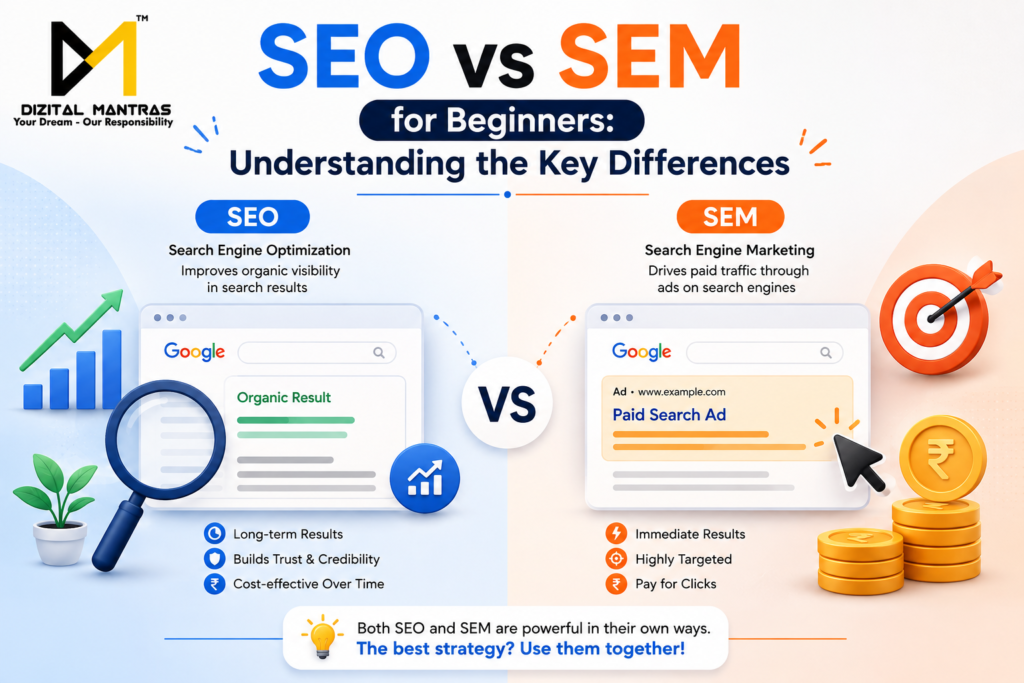
This is where SEO (Search Engine Optimization) and SEM (Search Engine Marketing) for beginners come into play. Both strategies help businesses appear in search engine results, attract potential customers, and increase website traffic. However, they work in very different ways.
SEO focuses mainly on improving organic search visibility, while SEM uses paid advertising and search marketing techniques to generate immediate visibility and traffic.
Understanding the difference between SEO and SEM can help businesses choose the right strategy, manage their marketing budget, and build a stronger online presence.
What Is SEO?
SEO, or Search Engine Optimization, is the process of optimizing a website and its content to improve its visibility in the organic search results of search engines such as Google.
The primary goal of SEO is to attract unpaid, relevant traffic by making a website more useful, trustworthy, technically sound, and search-engine friendly.
SEO is generally a long-term strategy. It may take time to produce significant results, but a well-optimized website can continue attracting organic traffic without paying for every click.
Key Elements of SEO
SEO includes several important activities:
- Keyword research
- On-page SEO
- Technical SEO
- Off-page SEO
- Content optimization
- Link building
- Website speed optimization
- Mobile optimization
- Internal linking
- Image optimization
- Local SEO
- User experience optimization
How SEO Works
Search engines use complex algorithms to understand and rank web pages.
When a user searches for something, the search engine analyzes thousands or millions of pages and attempts to show the most relevant and useful results.
SEO helps a website communicate its relevance and quality to search engines.
For example, if a business sells digital marketing courses, it may create useful content around topics such as:
- Digital marketing course
- SEO course for beginners
- Best digital marketing skills
- Digital marketing career
- SEO training
By creating valuable content and optimizing its website around relevant search queries, the business can improve its chances of appearing in organic search results.
What Is SEM?
SEM, or Search Engine Marketing, is a broader search marketing approach that commonly includes paid search advertising.
Businesses pay search platforms to display advertisements when users search for specific keywords.
For example, if someone searches for “best digital marketing course near me,” businesses may run paid search advertisements targeting relevant keywords.
These advertisements can appear prominently on the search results page, depending on factors such as the advertising platform, bid, relevance, ad quality, and competition.
Key Elements of SEM
SEM can involve activities such as:
- Paid search advertising
- Keyword targeting
- Ad creation
- Bid management
- Audience targeting
- Landing-page optimization
- Conversion tracking
- Campaign optimization
- Remarketing
The biggest advantage of paid search is speed. Once a campaign is properly created and approved, businesses can begin generating visibility and potentially traffic much faster than with organic SEO.
SEO vs SEM: The Major Difference
The simplest way to understand the difference is:
SEO = Organic visibility
SEM = Paid search visibility
SEO aims to earn visibility through optimization and valuable content, while paid search advertising involves paying for placements or clicks.
Both can be powerful, but they serve different purposes.
Factor| SEO| SEM
Meaning| Search Engine Optimization| Search Engine Marketing
Traffic| Mainly organic| Mainly paid
Cost| No direct payment for every organic click| Usually pay for clicks/impressions
Results| Usually slower| Usually faster
Long-term value| High| Depends on continued campaign spending
Main focus| Organic rankings| Paid search visibility
Content importance| Very high| Important for landing pages and ad relevance
Budget| Can require investment in content, tools, and expertise| Requires advertising budget
Sustainability| Can continue generating traffic| Traffic can stop when campaigns stop
Best for| Long-term growth| Quick visibility and lead generation
SEO vs SEM: Cost Comparison
One of the most important differences between SEO and SEM for beginners is how businesses pay for visibility.
SEO Costs
SEO does not generally require businesses to pay a search engine for every organic click.
However, SEO is not necessarily “free.”
Businesses may invest in:
- SEO professionals
- Content writers
- SEO tools
- Website development
- Technical improvements
- Content production
- Digital PR and link-building activities
The investment is often aimed at building sustainable organic visibility over time.
SEM Costs
SEM campaigns require a defined advertising budget.
Depending on the platform and campaign setup, advertisers may pay based on clicks, impressions, or other advertising objectives.
Costs can vary significantly depending on:
- Keyword competition
- Industry
- Location
- Audience
- Ad quality
- Campaign objectives
- Landing-page experience
For highly competitive keywords, paid advertising can become expensive.
SEO vs SEM: Which One Gives Faster Results?
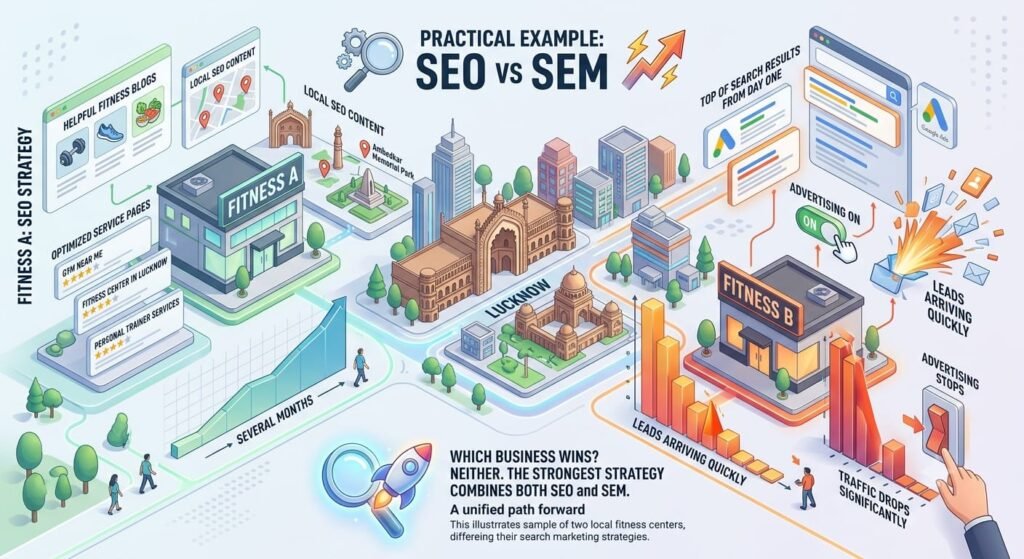
If speed is your priority, SEM generally has the advantage.
A business can launch a paid search campaign and potentially start receiving targeted traffic shortly after the ads become active.
SEO usually requires more patience.
A new website may need time to:
- Get discovered by search engines
- Build authority
- Publish useful content
- Earn quality links or mentions
- Improve technical performance
- Establish search visibility
Therefore, businesses looking for immediate traffic may prefer paid search, while businesses focused on long-term growth often invest heavily in SEO.
SEO vs SEM for beginners : Which One Gives Faster Results?
For long-term organic growth, SEO is extremely valuable.
Once a website establishes strong organic visibility for relevant search terms, it can potentially attract consistent traffic over an extended period.
For example, a well-written article ranking for a valuable search query may continue generating visitors months or even years after publication, provided it remains useful and competitive.
SEM, on the other hand, is more dependent on ongoing advertising investment.
When a campaign stops, the paid visibility associated with that campaign generally stops as well.
This makes SEO particularly useful for businesses that want to build a sustainable digital asset.
SEO vs SEM for beginners : Which One Gives Faster Results?
SEO offers several benefits for businesses.
- Builds Organic Traffic
SEO can help businesses attract people who are actively searching for their products, services, or information.
- Supports Long-Term Growth
A strong organic presence can become an important source of consistent website traffic.
- Builds Credibility
Users often view businesses that appear prominently in organic search results as more established or relevant.
- Improves Website Quality
SEO often requires improvements to website speed, navigation, mobile usability, content, and technical performance.
- Supports Content Marketing
SEO and content marketing work closely together. High-quality content can attract search traffic while also educating potential customers.
Advantages of SEM
SEM and paid search advertising also provide important benefits.
- Faster Visibility
Paid campaigns can provide exposure much faster than traditional SEO efforts.
- Precise Targeting
Advertisers can target audiences based on factors such as:
- Search keywords
- Location
- Device
- Language
- Audience characteristics
- Search intent
- Measurable Results
Digital advertising platforms provide detailed performance data.
Businesses can monitor metrics such as:
- Clicks
- Impressions
- Click-through rate
- Cost per click
- Conversions
- Conversion rate
- Return on ad spend
- Flexible Budget Control
Advertisers can usually define campaign budgets and adjust them based on performance.
- Useful for Promotions
SEM can be especially useful for time-sensitive campaigns, product launches, seasonal offers, and lead-generation campaigns.
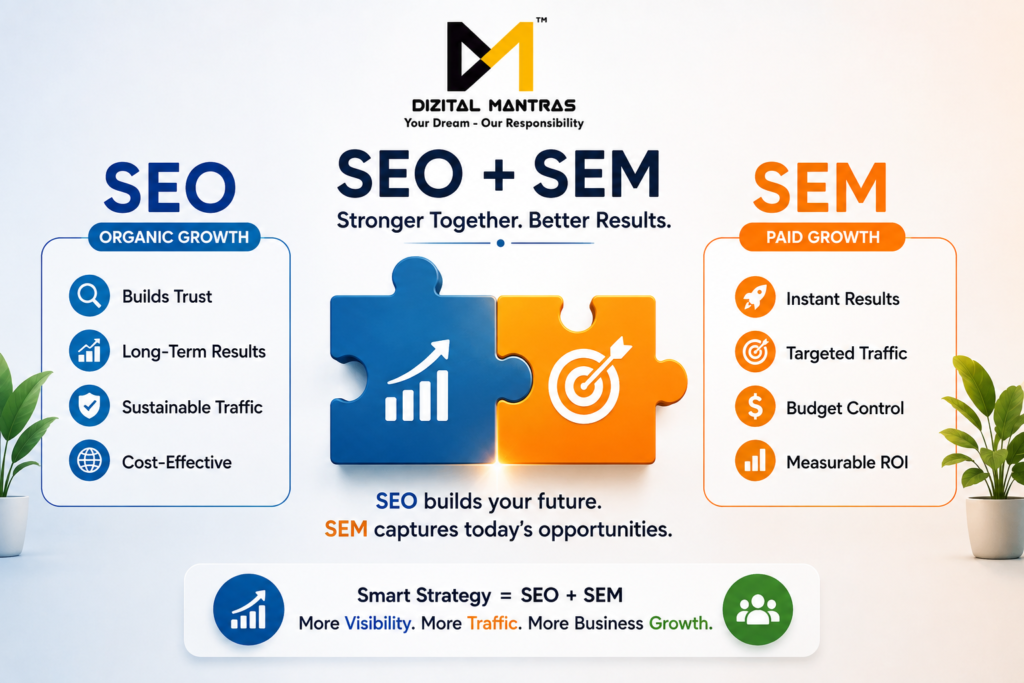
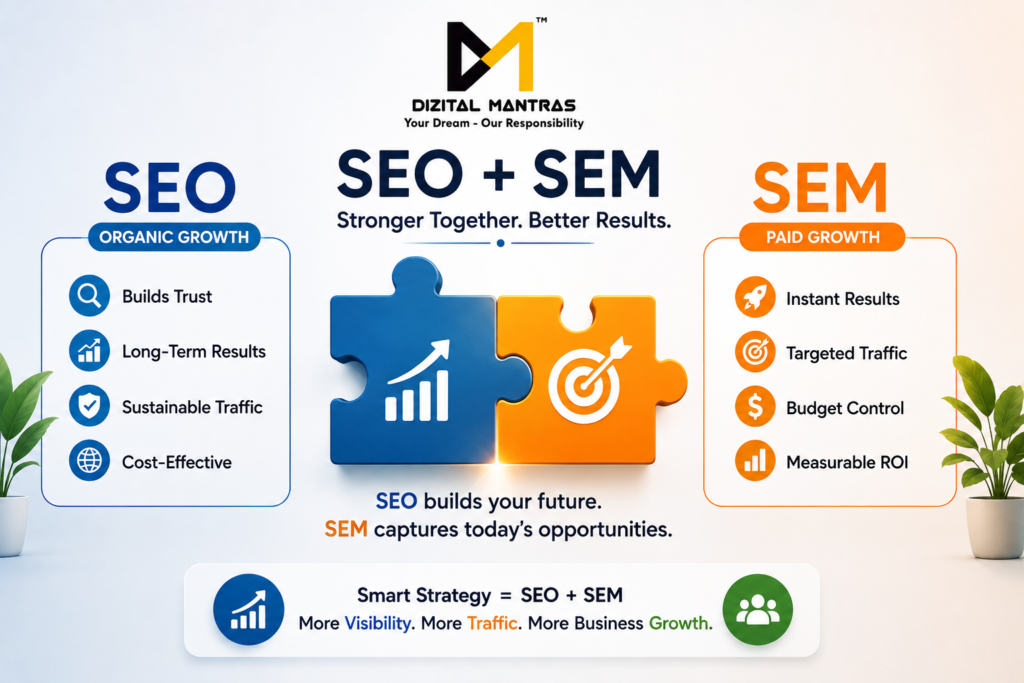
SEO and SEM for beginners Work Better Together
The real question should not always be “SEO or SEM for beggners?”
For many businesses, the better question is:
“How can we use SEO and SEM together?”
A combined strategy can create a powerful search marketing system.
For example, a company could use SEM to generate immediate traffic while simultaneously building SEO content for long-term organic growth.
This creates two different traffic channels:
Paid search → Immediate visibility
SEO → Long-term organic visibility
Together, they can support different stages of the customer journey.
When Should You Choose SEO?
SEO may be the better choice when:
- You want sustainable organic traffic.
- You are building a long-term online presence.
- You regularly publish useful content.
- You want to reduce dependence on paid advertising over time.
- Your audience frequently searches for information related to your business.
- You want to build topical authority.
- You have time to invest in long-term growth.
SEO is especially valuable for blogs, educational websites, service businesses, e-commerce websites, and brands with strong content strategies.
When Should You Choose SEM?
SEM may be appropriate when:
- You need traffic quickly.
- You are launching a new product.
- You want immediate lead generation.
- You are running a limited-time offer.
- You want to test keyword demand.
- You have a dedicated advertising budget.
- You want detailed campaign-level performance data.
Paid search can also help businesses test which keywords and offers generate conversions before investing heavily in long-term SEO content.
SEO and SEM in the Age of AI
The digital marketing landscape is changing rapidly because of artificial intelligence.
AI tools are increasingly being used for:
- Keyword research
- Content ideation
- Search intent analysis
- Ad copy creation
- Data analysis
- Competitor research
- Content optimization
- Campaign automation
However, AI does not eliminate the need for SEO or SEM for beginners?.
Instead, it is changing how marketers perform these activities.
Modern marketers need to focus not only on keywords but also on search intent, content quality, user experience, originality, trust, and measurable business outcomes.
The future of search marketing will likely require a combination of human creativity, strategic thinking, data analysis, and responsible use of AI tools.
Common Mistakes Businesses Make
Businesses often make mistakes when implementing SEO and SEM.
SEO Mistakes
- Keyword stuffing
- Publishing low-quality content
- Ignoring technical SEO
- Using irrelevant keywords
- Neglecting mobile users
- Ignoring search intent
- Building poor-quality links
- Never updating outdated content
SEM Mistakes
- Targeting overly broad keywords
- Writing weak ad copy
- Sending users to irrelevant landing pages
- Not tracking conversions
- Ignoring negative keywords
- Failing to test campaigns
- Spending without measuring return
- Optimizing only for clicks instead of business results
Avoiding these mistakes can significantly improve search marketing performanc
Which Is Better: SEO or SEM for beginners?
There is no universal answer.
The right choice depends on your:
- Business goals
- Budget
- Industry
- Competition
- Timeline
- Target audience
- Marketing strategy
If you need immediate visibility, SEM can be highly effective.
If you want sustainable organic growth, SEO is essential.
For many businesses, however, the strongest approach is to combine SEO and SEM for beginners rather than treating them as competing strategies.
Conclusion
SEO and SEM for beginners are two powerful components of modern digital marketing.
SEO focuses on earning organic visibility through website optimization, valuable content, technical improvements, and authority building. SEM focuses on paid search visibility and can provide faster access to targeted audiences.
SEO is generally a long-term investment, while SEM can deliver faster results when supported by an appropriate advertising budget.
The smartest digital marketing strategy is not necessarily about choosing one over the other. Instead, businesses should understand their goals and use each channel where it creates the most value.
At Dizital Mantras, we understand that every business needs a different search marketing strategy. Whether the goal is to build long-term organic visibility through SEO or generate faster results through SEM, choosing the right approach depends on your business goals, audience, and budget.
In simple words: SEO helps you build visibility for the future, while SEM can help you capture opportunities today.
When used strategically, SEO and SEM for beginners can work together to increase visibility, attract qualified visitors, generate leads, and support sustainable business growth.